The AI copywriting vs human copywriting debate is often framed as a cage match. One side says AI writes faster, cheaper, and good enough. The other says AI copy is bland and readers can smell it a mile away.
The latest research says both sides are partly right, and that’s exactly why the question matters for freelancers and small businesses. AI can now write copy most readers can’t identify as machine-made. Yet in head-to-head testing, human-made work still tends to win where it counts: emotional impact, brand memory, and sales.
This guide breaks down the real pros and cons of each, what 2026 research actually shows, and how to split the work between AI and humans so you get the speed of one and the results of the other.
Quick Answer: Is AI Copywriting Good?
Yes, for the right jobs. AI copywriting is good at fast first drafts, variations, product descriptions, and direct-response copy with a clear message. It’s weaker at original ideas, emotional storytelling, and anything where a factual mistake could cost you trust or money.
The best-performing approach in 2026 isn’t AI or human. It’s AI for speed and volume, with a human directing the strategy and editing the final copy.
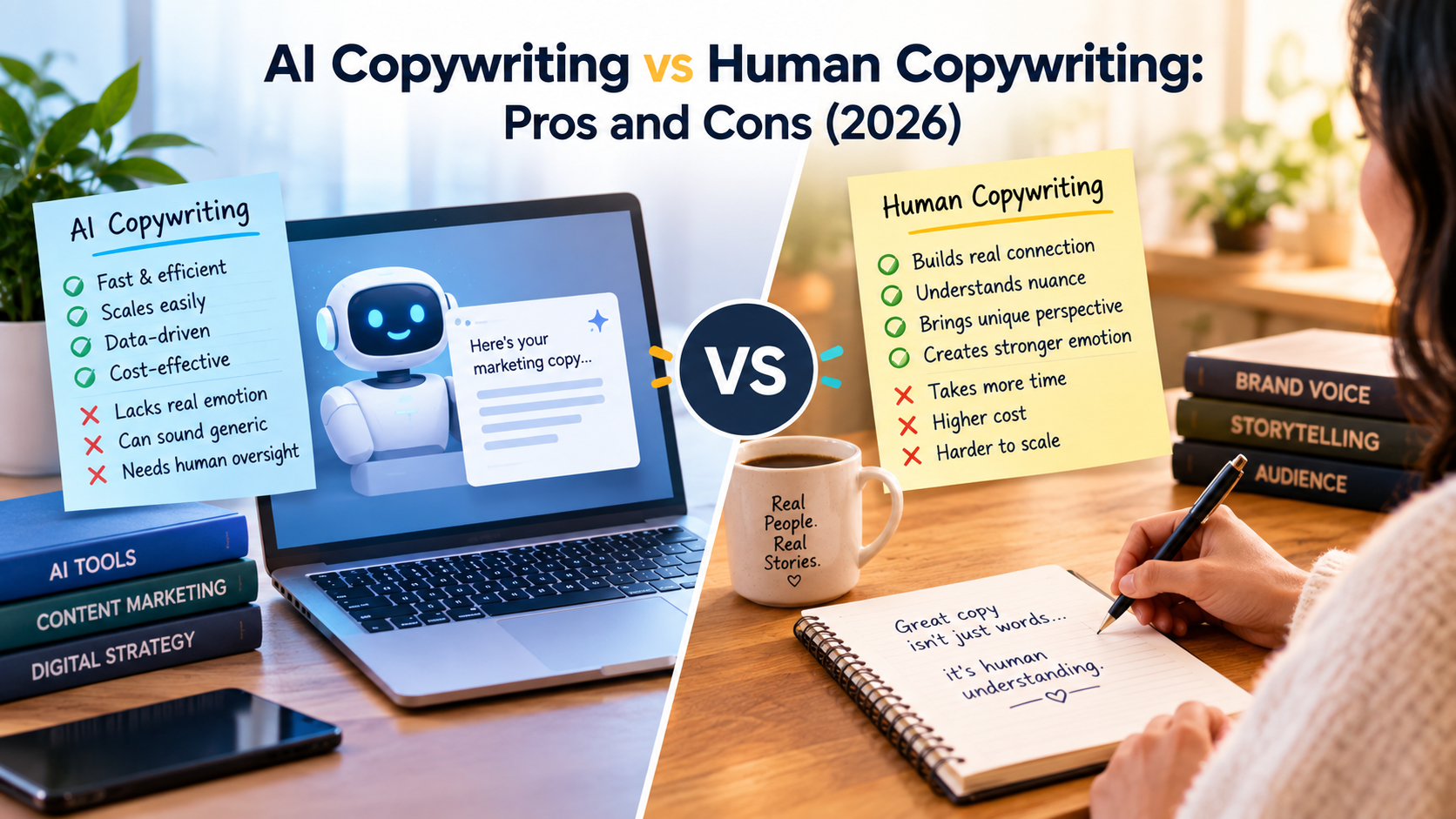
AI vs Human Copywriting: Side-by-Side Comparison
| Factor | AI Copywriting | Human Copywriting |
|---|---|---|
| Speed | Seconds to minutes per draft | Hours to days per project |
| Cost | Low monthly subscription | Higher per-project or hourly rates |
| Volume and variations | Dozens of versions on demand | Limited by time and budget |
| Original ideas | Remixes existing patterns | Can create genuinely new angles |
| Emotional resonance | Often polished but flat | Stronger storytelling and empathy |
| Accuracy | Can state errors confidently | Can verify and take responsibility |
| Brand voice | Good with training and samples | Strong, especially with experience |
| Strategy | Follows the brief it’s given | Can challenge and improve the brief |
| Copyright | Purely AI output isn’t protected in the U.S. | Protected as human authorship |
What the Research Says About AI vs Human Copy
The research on AI-generated content vs human content is more nuanced than most hot takes suggest.
Human-made ads still perform better on average. In a 2026 study, Ipsos and Syracuse University tested 20 video ads for 10 major brands with 3,000 U.S. consumers. Each pair was built from the same creative brief: a human-made original and a fully AI-generated version. The human-made ads scored 14% stronger on short-term effectiveness and 17% stronger on long-term brand effectiveness. Yet very few viewers could confidently tell which ads were made by AI. The AI ads that did best were product-driven and direct.
AI can win on persuasion. A 2025 arXiv study compared AI-written and human-written ads in two experiments. When ads were personalized to personality traits, AI and human copy performed at parity. When ads used classic persuasion principles such as authority, social proof, and scarcity, participants preferred the AI versions at 59.1% to 40.9%.
Trust is the wild card. A Gartner survey of 1,539 U.S. consumers found that half would prefer to do business with brands that don’t use generative AI in consumer-facing content. The same survey found that 68% frequently wonder whether the content they see is real.
What this means for you: AI can produce persuasive copy, but human creativity still tends to build stronger brands. Audiences are growing more skeptical, so how you use AI matters as much as whether you use it.
Pros of AI Copywriting
1. Speed
AI can turn a brief into a usable first draft in seconds. For freelancers juggling multiple clients, that time savings compounds quickly across emails, product pages, and social posts.
2. Lower Cost per Piece
AI copywriting tools charge a flat monthly fee, whether you generate 10 captions or 1,000. For small businesses without a copywriting budget, that’s often the difference between having copy and not having it.
3. Unlimited Variations for Testing
Need 20 headline options for an A/B test? Five versions of an email subject line? AI generates variations in seconds, so you can test more ideas and let data pick the winner. For tools built specifically for this, see our guide to the best AI tools for writing ad copy that converts.
4. No Blank-Page Problem
Even experienced writers get stuck. AI is excellent at producing outlines, angles, and rough drafts that give you something to react to and improve.
5. Consistency at Scale
Once you train AI on your brand voice (see our step-by-step brand voice guide), it can apply the same tone across hundreds of pieces. That’s hard to maintain across a team of writers.
Cons of AI Copywriting
1. Generic Output
AI predicts likely word patterns, so unguided AI copy tends toward the safe middle: tidy, agreeable, and forgettable. Without strong samples and a specific brief, your copy can sound like everyone else’s.
2. Confident Mistakes
AI can invent statistics, misstate product details, or cite non-existent sources, and it sounds equally confident either way. Every factual claim in AI copy needs a human check before it’s published.
3. Weaker Emotional Depth
The Ipsos research found consumers rated AI ads as less creative and less emotionally engaging, even when they didn’t know which ads were AI-made. For brand storytelling, that gap matters.
4. Copyright Limits
In the U.S., copyright requires human authorship. In March 2026, the Supreme Court declined to hear Thaler v. Perlmutter, leaving in place the ruling that work created entirely by AI can’t be copyrighted. Work with meaningful human creative input (selecting, arranging, or substantially modifying AI output) may still qualify. If you sell copy to clients, heavy human editing protects both of you.
5. Consumer Trust Risk
With half of U.S. consumers saying they’d prefer brands that avoid AI in customer-facing content, obviously AI-written copy can cost you credibility. This is especially true in trust-heavy niches like health, finance, and legal services.
Pros of Human Copywriting
1. Strategic Thinking
A good copywriter doesn’t just write what you ask for. They question the brief, spot a better angle, and connect the copy to your business goals. AI follows instructions; humans can improve them.
2. Original Ideas and Real Experience
Humans draw on lived experience, customer conversations, and cultural context that AI doesn’t have. That first-hand perspective is also what Google’s quality guidelines reward under E-E-A-T (experience, expertise, authoritativeness, and trustworthiness).
3. Emotional Storytelling
Humor, empathy, tension, a turn of phrase that sticks: this is where human copywriters still clearly lead, and where brand-building campaigns are won.
4. Accountability
A human writer can verify facts, understand legal and compliance risks, and stand behind their work. When the stakes are high, that accountability is worth paying for.
Cons of Human Copywriting
1. Higher Cost
Experienced copywriters charge accordingly. For businesses that need high volumes of routine copy, a fully human approach can get expensive fast.
2. Slower Turnaround
Research, drafting, and revisions take time. Human copywriting can become a bottleneck for fast-moving campaigns or large product catalogs.
3. Limited Scale
One writer can only produce so much. Scaling up means hiring more writers, which introduces voice inconsistencies and more editing.
4. Variable Quality
Quality depends heavily on the individual writer. Finding, vetting, and managing good freelancers is a time investment in itself.
Does Google Penalize AI Content?
No, not simply for being AI-generated. Google’s Search Central guidance says generative AI can help with researching topics and structuring original content. It warns, however, that using AI to mass-produce pages without adding value for users may violate its scaled content abuse policy.
In other words, Google judges the content, not the tool. A thin, AI-generated page and a thin human-written page face the same risk. For SEO copywriting, the safest approach is to use AI to speed up research and drafting, then add original insight, real examples, and expert review before you publish.
When to Use AI vs a Human Copywriter
Here’s a practical breakdown of which copywriting tasks fit which approach:
| Copy Type | Best Fit | Why |
|---|---|---|
| Product descriptions (large catalogs) | AI + human review | High volume, clear facts, repeatable format |
| Ad copy variations for testing | AI | Speed and volume matter most; data picks the winner |
| Social media captions | AI + human edit | Fast drafts, human polish for voice and timing |
| Email subject lines | AI | Easy to generate and A/B test |
| SEO blog posts | Hybrid | AI for research and outlines, human for insight and E-E-A-T |
| Sales pages and landing pages | Human-led | High stakes; strategy and persuasion drive revenue |
| Brand campaigns and taglines | Human | Originality and emotional resonance are the point |
| Regulated industries (health, finance, legal) | Human | Accuracy, compliance, and accountability required |
The Hybrid Copywriting Workflow That Works
The strongest results come from combining both. Here’s a simple hybrid copywriting workflow any freelancer or small team can use:
- A human writes the brief. Define the audience, goal, key message, offer, and proof points. The quality of AI output depends on the quality of this brief.
- AI drafts and generates options. Ask for multiple angles, headlines, and versions rather than one “final” draft.
- A human chooses and rewrites. Pick the strongest direction, then rewrite the opening, add real examples, and inject personality.
- A human fact-checks everything. Verify every statistic, claim, name, and product detail.
- Test and learn. Run variations, track performance, and feed the winners back into your AI brand voice samples.
Choosing the right tool matters too. See our guides to the best AI writing assistants for marketing and how to choose the right AI writing tool for your business.
Will AI Replace Copywriters?
AI is replacing some copywriting tasks, especially high-volume, low-stakes work like basic product descriptions and routine social posts. It isn’t replacing copywriters who bring strategy, originality, and judgment.
The role is shifting. Copywriters who use AI to handle drafts and variations can take on more clients and spend more time on the high-value work AI still does poorly. The research backs this up: AI can match or beat humans on narrow persuasion tasks, but human-made creative still drives stronger brand results on average.
The copywriters most at risk are those competing with AI on speed and price alone. The safest position is to direct the AI, not compete with it.
The Bottom Line
AI copywriting vs human copywriting isn’t an either-or decision anymore. AI wins on speed, cost, and volume. Humans win on strategy, originality, emotional depth, and trust.
Use AI for drafts, variations, and repeatable formats. Keep humans in charge of the brief, the big ideas, the final edit, and the fact-check. Do that, and you’ll get the efficiency of AI without the generic copy, factual errors, or trust problems that come with using it alone.
Start small: pick one repeatable copy task this week, like product descriptions or email subject lines. Run it through the hybrid workflow above, and compare the results to your current process.
Frequently Asked Questions About AI vs Human Copywriting
Q: Is AI copywriting good enough to use without editing? A: For low-stakes copy like internal drafts or test variations, sometimes. For anything customer-facing, no. AI can state errors confidently and tends toward generic phrasing, so a human should review, fact-check, and edit before publishing.
Q: Can people tell the difference between AI and human copywriting? A: Often not. In the 2026 Ipsos and Syracuse study, very few consumers could confidently identify which ads were AI-generated. Yet the human-made ads still performed better on average.
Q: Does Google penalize AI-generated content? A: Not for being AI-generated. Google focuses on content quality. Mass-producing AI pages that don’t add value for users can violate its scaled content abuse policy, but helpful, original content can rank regardless of how it was produced.
Q: Can I copyright AI-generated copy? A: In the U.S., content created entirely by AI can’t be copyrighted, a principle left in place when the Supreme Court declined to hear Thaler v. Perlmutter in March 2026. Copy with meaningful human creative contribution may be protected. For specific situations, consult an intellectual property attorney.
Q: Is it cheaper to use AI or hire a copywriter? A: AI is cheaper per piece, especially at high volume. A human copywriter often delivers a better return on high-stakes copy like sales pages and brand campaigns. Most businesses get the best value by using AI for routine work and hiring humans for strategic projects.
Q: What types of copy should I never fully hand off to AI? A: Sales pages, brand taglines, crisis communications, and anything in regulated industries like health, finance, or legal. These require accuracy, accountability, and judgment that AI can’t guarantee.
You May Also Like
- 10 Best AI Writing Assistants for Marketing in 2026
- How to Train AI on Your Brand Voice (Step-by-Step)
- ChatGPT vs Claude for Marketing Copy: Which Is Better in 2026?
- Copy.ai vs Jasper: Which AI Writing Tool Wins in 2026?
- Anyword Review 2026: Is the Predictive Performance Score Worth It for Marketers?