Some links on this page are affiliate links. If you click through and make a purchase, we may earn a small commission at no extra cost to you.
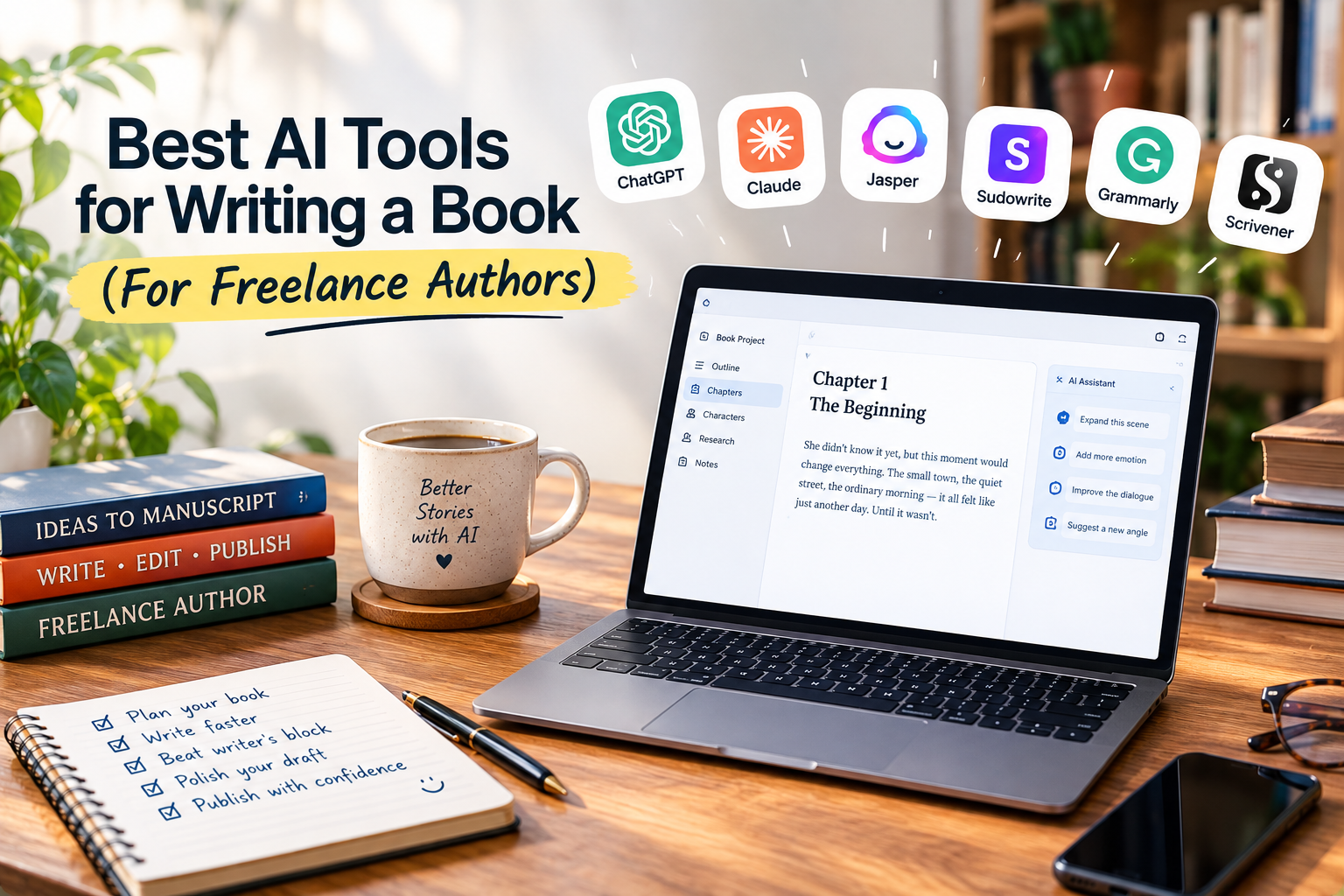
If you’re a freelance author, you’ve probably stared at a blank page wondering how you’ll ever finish that manuscript. The good news is that a new generation of AI tools is designed specifically for book-length projects, not just generic copywriting.
General-purpose chatbots like ChatGPT and Claude are powerful, but they don’t automatically keep track of your whole story. Specialized book-writing tools add story bibles that remember your characters, fiction-focused AI models, and manuscript organization that helps you stay consistent across 90,000 words.
This guide covers the best AI tools for writing a book in 2026, whether you’re drafting a novel, a memoir, or a nonfiction business book.
Quick Answer: What is the best AI tool for writing a book? Sudowrite is the best all-around choice for fiction, with a Story Bible and fiction-focused AI from $10/month billed annually. Novelcrafter is best for long series if you bring your own AI. Claude and ChatGPT are flexible free options, and ProWritingAid is best for self-editing a finished draft.
Quick Comparison: Best AI Tools for Writing a Book
| Tool | Best For | Starting Price | Free Option |
|---|---|---|---|
| Sudowrite | Fiction drafting | $10/mo (annual) or $19 monthly | Free trial credits |
| Novelcrafter | Long novels and series | $4–$20/mo + your own AI costs | 21-day trial |
| NovelAI | Genre and mature fiction | From about $10/mo | Limited trial |
| Squibler | Beginners and visual plotters | Free plan; paid plans available | ✅ Free plan |
| Claude | Long-form prose and editing | $17/mo (annual) or $20 monthly | ✅ Free plan |
| ChatGPT | Brainstorming and drafting | Go $8/mo (U.S.); Plus $20/mo | ✅ Free plan |
| Scrivener | Manuscript management | About $60 one-time | Free trial |
| ProWritingAid | Self-editing a finished draft | $10/mo (annual) or $30 monthly | ✅ Free plan |
| Grammarly | Grammar and clarity | $12/mo (annual) | ✅ Free plan |
Table: Prices checked September–October 2026. Confirm current pricing on each vendor’s site.
What Makes a Great AI Book Writing Tool?
- It understands story structure, characters, and tone, not just grammar.
- It helps you brainstorm and get unstuck.
- It keeps long manuscripts consistent, remembering what happened in chapter three.
- It’s easy to guide with plain-language instructions.
The best AI writing software isn’t the one that writes for you. It’s the one that keeps you writing.
The Top AI Tools for Writing a Book
1. Sudowrite: Best Overall for Fiction Authors
Sudowrite is built specifically for fiction writers. Its Muse model is designed for storytelling, and its tools focus on voice, pacing, and scene construction rather than generic text.
Key features:
- Story Bible: Stores your characters, world, outline, and synopsis, and refers back to them when generating text
- Muse: A fiction-focused AI model for narrative prose
- Write, Rewrite, and Describe tools: Continue a scene, revise passages, and add sensory detail
Pricing: Hobby & Student costs $10/month billed annually or $19 monthly (225,000 credits a month). Professional costs $22/month annually or $29 monthly (1 million credits). Max costs $44/month annually or $59 monthly (2 million credits, with 12-month rollover). New users get free trial credits.
The catch: Credits on the Hobby and Professional plans don’t roll over, and heavy drafting can push you to a higher tier.
2. Novelcrafter: Best for Long Novels and Series
Novelcrafter is a popular organizer among self-published authors. It combines a Codex (a wiki for your world and characters), scene planning, and AI drafting in a distraction-free editor. You bring your own AI by connecting an account with a provider such as OpenRouter.
Key features:
- Codex: Organizes your world, characters, and lore, and can be shared across a series
- Scene-by-scene planning and drafting
- Model choice: Use the AI models you prefer
Pricing: Scribe $4/month (no AI features), Hobbyist $8/month (AI with your own key), Artisan $14/month, and Specialist $20/month, plus your AI provider’s costs. There’s a 21-day free trial.
The catch: A real learning curve, and you manage your own AI account and bills.
3. NovelAI: Best for Genre and Mature Fiction
NovelAI is a fiction-focused AI service with fewer content restrictions than mainstream assistants, which makes it popular for romance, horror, and dark fantasy. Its Lorebook feature helps the AI remember story details.
Pricing: Paid plans start at about $10/month, with higher tiers offering more memory. A limited free trial is available.
The catch: A smaller ecosystem and fewer integrations than mainstream tools.
4. Squibler: Best for Beginners and Visual Plotters
Squibler is an all-in-one AI writing app that combines drafting, planning, and organization, with drag-and-drop chapter and scene planning that suits visual thinkers.
Pricing: A free plan with limited AI credits is available, plus paid plans. Check Squibler’s pricing page for current limits.
The catch: Less specialized for fiction than Sudowrite.
5. Claude: Best for Long-Form Prose and Editing
Claude, from Anthropic, is a popular general assistant for long-form writing. It can work with long documents, like a full outline plus several chapters, and many writers like its natural prose style.
What it offers authors: Projects for each book, help with outlining and editing, and feedback on structure and pacing.
Pricing: Free plan available. Pro costs $17/month billed annually or $20 monthly.
The catch: No built-in story bible or manuscript manager, so you’ll keep your notes and chapters organized yourself.
6. ChatGPT: Best for Brainstorming and Drafting
ChatGPT is a strong all-rounder for brainstorming plots, outlining chapters, and drafting. Custom GPTs and Projects let you save instructions and notes for repeat tasks.
Pricing: Free plan available. Go costs $8/month in the U.S., and Plus costs $20/month. Compare it with Claude in our ChatGPT vs Claude breakdown.
The catch: No built-in story bible, so you’ll need to supply story context yourself.
7. Scrivener: Best for Manuscript Management
Scrivener isn’t an AI writer. It’s a manuscript organizer with a binder, corkboard, outliner, and split views, and it compiles your book into DOCX, PDF, and EPUB. Many authors draft with AI elsewhere and organize in Scrivener.
Pricing: About $60 one-time for desktop, with a separate iOS app. No subscription.
The catch: No AI features, so pair it with an AI tool for drafting.
8. ProWritingAid: Best for Self-Editing
ProWritingAid helps you polish a finished manuscript with grammar, style, and readability checks, plus 25+ writing reports. It works in Word, Google Docs, Scrivener, and its own editor.
Pricing: Free plan (500 words per check). Premium costs $120/year (about $10/month) or $30 monthly, with a $399 lifetime option. A higher Premium Pro tier is also available.
The catch: It’s an editing tool, so it’s most useful after you’ve finished a draft.
9. Grammarly: Best for Grammar and Clarity
Grammarly catches grammar and spelling errors, flags tone, and suggests clearer phrasing as you write.
Pricing: Free plan (100 AI prompts a month). Pro costs $12/month billed annually or $30 monthly.
The catch: An editor, not a story tool. ProWritingAid offers deeper reports for long manuscripts.
Before You Publish: Copyright and Disclosure
Two rules matter if you plan to sell your book:
- Copyright: In the U.S., purely AI-generated text can’t be copyrighted. In March 2026, the Supreme Court declined to hear Thaler v. Perlmutter, leaving that rule in place. Your own creative contributions, such as writing, substantial editing, and selection and arrangement, can still be protected. The more of the book that’s genuinely yours, the stronger your position.
- Amazon KDP disclosure: Amazon asks self-publishers to disclose AI-generated content (text, images, or translations) when publishing on KDP. AI-assisted content you’ve substantially edited is treated differently, so read KDP’s current guidelines before you upload.
For more on these trends, see the future of AI copywriting.
How to Choose the Right AI Tool for Writing a Book
For Fiction Novelists
- Want a story bible and fiction-focused AI? Sudowrite.
- Writing a long series? Novelcrafter.
- Writing mature or dark fiction? NovelAI.
- On a budget? Start with ChatGPT’s or Claude’s free plan.
For Nonfiction Authors
- Outlining and drafting: Claude or ChatGPT, with a Project for your book’s research and notes.
- Research: A cited research tool like Perplexity. See the best AI research tools.
- Organization: Scrivener for structuring chapters.
For Self-Editing
- Finished your draft? ProWritingAid for in-depth self-editing.
- Everyday polish? Grammarly.
Common Mistakes to Avoid
Mistake 1: Letting AI Write Your Book for You
The best AI tools are collaborators, not ghostwriters. Use AI for rough drafts, alternate versions of dialogue, and plot stalls, then edit every line until it sounds like you. That’s also what protects your copyright.
Mistake 2: Ignoring Story Consistency
General chatbots don’t automatically remember your whole story, which leads to changing eye colors and plot holes. Use a story bible (Sudowrite or Novelcrafter’s Codex), or keep a character and timeline document you paste into each session. Our guide on training AI on your voice also helps keep your style consistent.
Mistake 3: Using the Wrong Tool for the Job
A chatbot is great for brainstorming but doesn’t manage a manuscript. Fiction tools are great for novels but less useful for nonfiction research. Build a small stack of complementary tools.
Mistake 4: Skipping the Free Trials
ChatGPT, Claude, Squibler, ProWritingAid, and Grammarly have free plans, and Sudowrite and Novelcrafter offer trials. Test on a real chapter before committing.
The Bottom Line
The best AI tools for writing a book are the ones that fit your genre, workflow, and budget.
Start with one tool. For fiction, Sudowrite’s Story Bible and fiction-focused AI are genuinely useful. On a budget, ChatGPT or Claude covers a lot for free or about $20 a month. For nonfiction, pair a general assistant with a research tool and Scrivener.
Pick one tool from this guide. Set it up this week. Write your next chapter with it.
Frequently Asked Questions About AI Book Writing Tools
Q: What’s the best AI tool for writing a book?
A: For fiction, Sudowrite, thanks to its Story Bible and fiction-focused AI. For nonfiction, a general assistant like Claude or ChatGPT paired with a research tool works well.
Q: Can AI write a complete book?
A: It can generate full drafts, but the best results come from using AI as a collaborator while you provide the creative vision and final polish. Purely AI-generated text also can’t be copyrighted in the U.S.
Q: Do I have to disclose AI use when self-publishing?
A: On Amazon KDP, you’re asked to disclose AI-generated content when you publish. Check KDP’s current guidelines for what counts as AI-generated versus AI-assisted.
Q: Are there free AI book writing tools?
A: Yes. ChatGPT, Claude, Squibler, ProWritingAid, and Grammarly have free plans, and Sudowrite and Novelcrafter offer trials.
Q: How much do AI book writing tools cost?
A: From free to about $60 a month. Sudowrite starts at $10/month billed annually, Novelcrafter at $4–$20/month plus AI costs, and Scrivener costs about $60 once.
You May Also Like
- Best AI for Creative Writing (Fiction, Poetry, and Scripts)
- Best AI Tools for Blog Writing (Ranked for Freelancers)
- Best AI Tools for Writing Research Papers (2026)
- AI Copywriting vs Human Copywriting: Pros and Cons (2026)
- Best Free AI Copywriting Tools (No Credit Card Required)
- The Ultimate Guide to the Best AI Tools for Freelancers (2026)