A few years ago, the big question was whether AI could write usable copy at all. That question is settled. The future of AI copywriting now turns on harder questions. What happens when everyone has the same tools? How do you write for search engines to answer questions rather than drive clicks? And what do audiences, regulators, and courts expect from AI-assisted content?
This guide covers the eight trends shaping AI copywriting in 2026, backed by the latest research, plus what each one means for freelancers, marketers, and small business owners.
Quick Answer: What is the future of AI copywriting? AI copywriting is becoming a standard tool, so speed alone is no longer an advantage. The future belongs to copywriters who pair AI with human strengths: strategy, original insight, and editing. Key trends include AI search, personalization, stricter disclosure rules, copyright limits on AI-only work, and rising demand for authentic content.
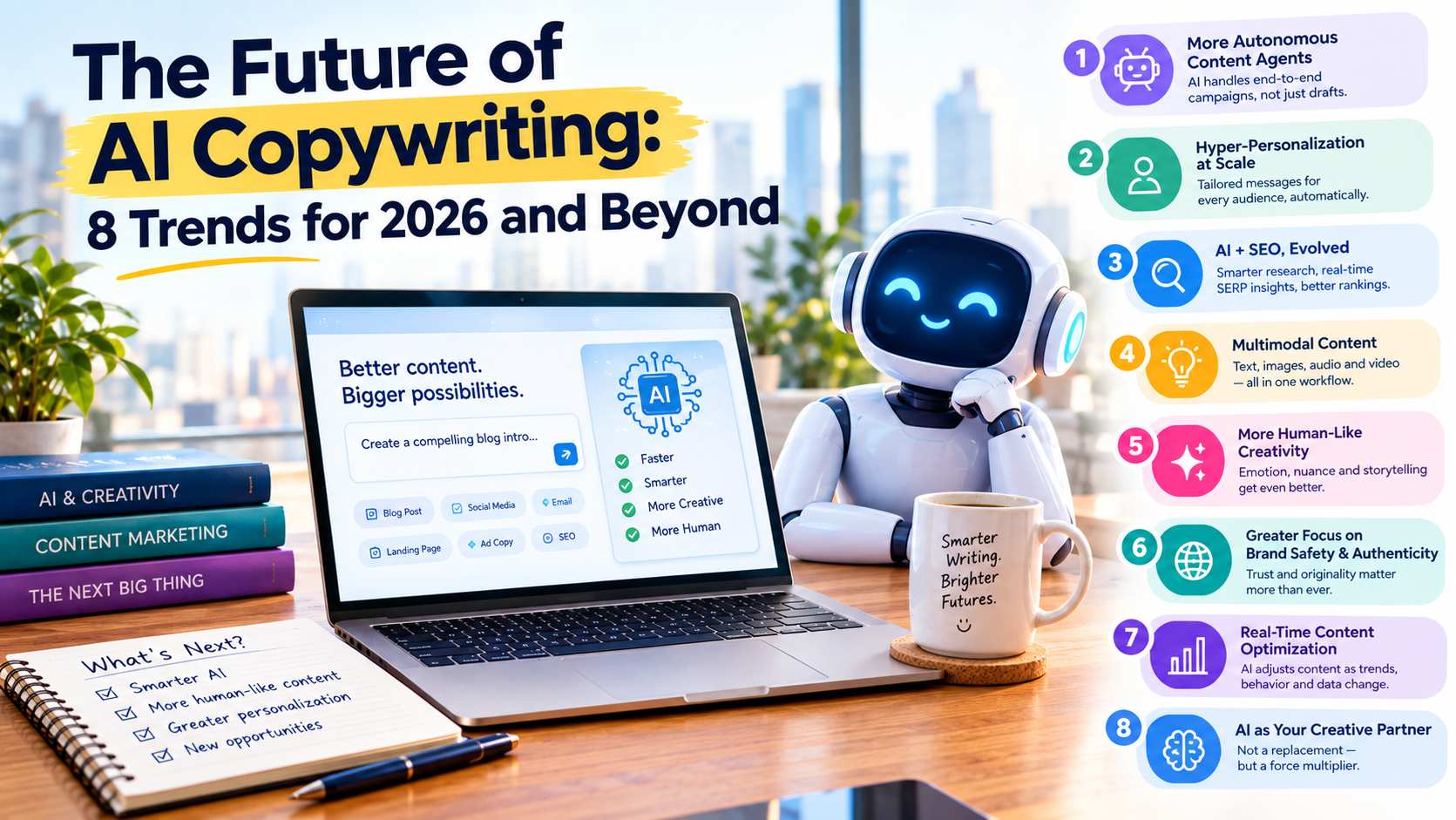
8 AI Copywriting Trends for 2026 at a Glance
| Trend | What’s Changing | What It Means for You |
|---|---|---|
| 1. AI is table stakes | Most social media managers now use AI daily | Speed alone is no longer an advantage |
| 2. Human-made is a premium | Audiences reward authenticity and punish “slop” | Human insight becomes the differentiator |
| 3. Writing for AI search | AI summaries are linked to fewer clicks to websites | Content must be quotable and citable |
| 4. Personalization at scale | AI tailors copy to individuals | Brand voice and audience data matter more |
| 5. Agentic workflows | AI handles multi-step tasks, not just drafts | Copywriters become workflow directors |
| 6. Disclosure rules tighten | New laws and platform labels | Transparency becomes a compliance issue |
| 7. Ownership questions | Purely AI output can’t be copyrighted in the U.S. | Human contribution protects your work |
| 8. The copywriter’s role shifts | Routine writing work shrinks | Strategy and expertise command the premium |
Trend 1: AI Copywriting Is Now Table Stakes
AI writing is no longer a competitive edge. It’s the baseline. Hootsuite’s 2026 Social Trends research found that 79% of social media managers now use AI daily.
When everyone can produce a competent first draft in seconds, competent first drafts cease to be valuable. Winners will be the people who direct AI well: better briefs, better source material, better editing, and better judgment about what’s worth publishing.
What to do: Stop measuring your AI use by volume. Measure it by how much time it frees for the work AI can’t do: strategy, original research, and client relationships.
Trend 2: Human-Made Content Becomes a Premium Signal
As AI content floods feeds and inboxes, audiences are becoming more skeptical and more drawn to work that feels human.
The research is consistent:
- A Gartner survey of 1,539 U.S. consumers, conducted in October 2025, found that half would prefer to do business with brands that don’t use generative AI in consumer-facing content.
- Sprout Social found that 55% of social media users are more likely to trust brands that publish human-generated content.
- A 2026 Ipsos and Syracuse University study compared human-made video ads with fully AI-generated versions built from the same brief. The human-made ads scored 14% higher on short-term effectiveness and 17% higher on long-term brand effectiveness, even though few viewers could confidently identify which ads were AI-made.
This doesn’t mean AI content fails. The same Ipsos study found AI performed best on direct, product-focused ads. But for brand-building work, human creativity still carries measurable weight. Our breakdown of AI copywriting vs human copywriting covers where each wins.
What to do: Put your human contribution where it’s visible, like original stories, real results, and personal opinions. Let AI handle the invisible parts.
Trend 3: Writing for AI Search, Not Just Google Rankings
Search is changing faster than any other part of the copywriting landscape. AI-generated summaries now answer many questions directly on the results page.
A Pew Research Center analysis of real browsing data from March 2025 found that Google users clicked a traditional search result in 15% of visits to results pages without an AI summary, but in only 8% of visits when an AI summary appeared. Just 1% of visits to pages with an AI summary led to a click on a source cited inside it. Pew notes that the data show an association, not proof of causation, and that Google has disputed the study’s methodology. But the direction matches what many publishers report.
This shift has given rise to generative engine optimization (GEO), closely related to answer engine optimization (AEO): writing content that AI systems can easily understand, trust, and cite. In practice, that means:
- Clear, direct answers near the top of each section
- Specific facts and original data that AI tools want to quote
- Obvious expertise signals, like named authors, first-hand experience, and credible sources
- Strong brand recognition, so people search for you by name instead of relying on generic queries
What to do: Structure content so each section answers one question clearly. Add original insights, examples, or data that can’t be found elsewhere. That’s what makes content worth citing.
Trend 4: Personalization at Scale
Personalization used to mean inserting a first name into an email. AI makes it possible to tailor tone, angle, and message to specific audiences, and people increasingly expect it.
A 2025 Google Workspace survey of U.S. knowledge workers aged 22–39 who hold or aspire to leadership roles found that 92% want AI with personalization, meaning output tailored to their writing style or their organization’s brand guidelines. And a 2025 arXiv study found that AI-written ads performed on par with human-written ads when both were tailored to readers’ personality traits.
The catch: personalization only works when AI has good inputs. Generic prompts produce generic “personalized” copy.
What to do: Invest in your inputs, like a documented brand voice, clear audience profiles, and real customer language. Our guide to training AI on your brand voice shows you how to build that foundation.
Trend 5: From AI Assistants to Agentic Workflows
The next shift is from AI that drafts to AI that does. AI agents can take on multi-step tasks, such as researching a topic, drafting a brief, formatting content, and preparing social posts, with less step-by-step prompting.
Automation platforms are already building this in. Make, for example, now offers AI Agents alongside its standard automations. For copywriters, this means more of the writing process can run automatically, while the writing itself still needs human direction.
What to do: Learn the basics of workflow automation now, while the stakes are low. Our guide on automating your content workflow with AI walks through beginner-friendly setups and where to keep humans in the loop.
Trend 6: Disclosure and Transparency Rules Tighten
AI transparency is moving from good practice to legal requirement, at least in some places and for some content.
In the EU: Transparency rules under Article 50 of the EU AI Act apply from August 2, 2026. AI providers must mark synthetic content in a machine-readable way. Deployers must disclose deepfakes and label AI-generated text published on matters of public interest. There’s an exception for AI-assisted text that a human has reviewed and taken editorial responsibility for. Most everyday marketing copy isn’t “public interest” text, but if you publish news-style content for EU audiences, get proper legal advice.
On social platforms: TikTok, YouTube, and Meta all have labeling systems for realistic AI-generated images, video, or audio. For a platform-by-platform breakdown, see our guide on how to use AI for social media content creation.
With audiences: Sprout Social found that brands posting AI-generated content without disclosing it ranked among consumers’ top concerns about brands on social media.
What to do: Build a simple disclosure policy now. Decide when you label AI involvement and apply it consistently. Transparency is cheaper than a trust crisis.
Trend 7: Ownership and Copyright Questions Get Real
Who owns AI-written copy? In the U.S., the answer has become clearer, at least for content created entirely by AI.
In March 2026, the U.S. Supreme Court declined to hear Thaler v. Perlmutter, leaving in place lower-court rulings that works created entirely by AI, without meaningful human involvement, can’t receive copyright protection. The harder question remains open: how much human input is required for AI-assisted work to be protectable? Copyright Office guidance indicates that human selection, arrangement, or creative modification of AI output may qualify.
For freelancers selling copy to clients, this matters. Clients expect to own what they pay for.
What to do: Make your human contribution substantial, and document your process. Heavy editing, original structure, and your own ideas strengthen your claim to authorship. For contract questions, talk to an intellectual property attorney.
Trend 8: The Copywriter’s Role Shifts Toward Strategy
The job market is already feeling AI’s effects, especially for routine writing.
An early study of the freelance platform Upwork found that in the months after ChatGPT’s release, writing-related freelancers saw a 2% decline in monthly jobs and a 5.2% decline in monthly earnings. A broader review of research found that demand for easily automated freelance work, such as writing, fell sharply after ChatGPT’s release, while employers increasingly sought more complex, higher-value tasks.
The International AI Safety Report 2026 notes that the overall evidence on employment remains mixed. But it also points to concentrated effects on specific jobs and on junior workers.
The pattern is clear: AI is compressing demand for commodity copy while leaving room at the top for writers who bring strategy, specialist knowledge, and measurable results. (For a deeper look at whether AI will replace copywriters, see our AI vs human copywriting comparison.)
What to do: Move up the value chain. Position yourself around outcomes, like conversions, strategy, and specialist expertise, rather than word counts.
What This Means for Freelancers: Skills Worth Building
Based on these trends, here are the skills most likely to keep copywriters valuable through 2026 and beyond:
| Skill | Why It Matters |
|---|---|
| Strategic briefing | AI output is only as good as the brief behind it |
| Editing and fact-checking | Accuracy and voice are where AI still fails most often |
| Niche expertise | First-hand knowledge is hard to automate and valued by search engines |
| Original research and data | Unique facts get cited by AI search tools |
| Workflow automation | Automating the busywork frees time for high-value work |
| Measurement | Clients pay for results, not word counts |
Our Predictions: AI Copywriting Beyond 2026
These are our forecasts based on the trends above, not certainties:
- “Human-written” becomes a selling point. Expect more brands and freelancers to market human-led content as a premium, similar to “handmade” in physical goods.
- Citations become a key metric. As AI search grows, being quoted by AI tools may matter as much as ranking in traditional search results.
- Disclosure becomes standard practice. Amid regulation, platform labels, and audience expectations, clear AI disclosure policies will likely become the norm for professional content teams.
- Hybrid workflows win. The most effective teams will use AI for speed and scale, with humans owning strategy, voice, and final approval.
- Commodity copy keeps getting cheaper. Prices for simple, generic writing will likely continue to fall, while specialized, results-driven copywriting will hold its value.
The Bottom Line on the Future of AI Copywriting
The future of AI copywriting isn’t humans versus machines. It’s a market where AI handles more of the production, and human judgment becomes the scarce ingredient. Audiences want authenticity, search engines want citable expertise, regulators want transparency, and clients want work they can own.
Copywriters who adapt will use AI to move faster, while doubling down on what AI can’t replicate: original thinking, real experience, and accountability for the final result.
Start now: pick one trend from this guide that affects your work most. Make one change this month, such as writing a disclosure policy, restructuring a key page for AI search, or automating a repetitive task.
Frequently Asked Questions About the Future of AI Copywriting
Q: Will AI replace copywriters? A: AI is replacing some routine copywriting tasks, and research shows declining demand for commodity writing on freelance platforms. But copywriters who bring strategy, specialist expertise, and results remain in demand. The role is shifting, not disappearing.
Q: What are the biggest AI copywriting trends in 2026? A: The biggest trends are AI becoming standard in marketing workflows, rising demand for authentic human-made content, optimization for AI-powered search, personalization at scale, agentic workflows, new disclosure rules, and open questions about copyright ownership.
Q: What is generative engine optimization (GEO)? A: GEO is the practice of creating content that AI systems, like AI search summaries and chatbots, can easily understand and cite. It emphasizes clear answers, original facts, and strong signals of expertise.
Q: Do I have to disclose AI-written copy? A: It depends on where and what you publish. Social platforms require labels for certain realistic AI-generated media. In the EU, AI Act transparency rules apply from August 2026, including labels for AI-generated text on matters of public interest unless a human has reviewed it and taken editorial responsibility. When in doubt, disclose, and consult a legal professional for your specific situation.
Q: Can I copyright content written with AI? A: In the U.S., content created entirely by AI can’t be copyrighted. Work with meaningful human creative contribution may be protected. The exact threshold is still being worked out, so document your human input and consult an IP attorney for important projects.
Q: What skills should copywriters learn to stay relevant? A: Focus on strategic briefing, editing and fact-checking, niche expertise, original research, workflow automation, and measuring results. These are the areas where human copywriters add the most value alongside AI.